- The median income in Marietta remains nearly $10,000 less than the statewide average, and 25 percent of Marietta residents – and nearly 4 in 10 children – live below the poverty line.
- The workforce in Marietta has shrunk by 5 percent over the last five years, declining from 6,868 in 2010 to 6,505 today.
- The bottom 20% of income earners in Marietta have seen state taxes increase as a result of a shift to a more regressive tax code.
- Medicaid expansion has resulted in over 3,000 Washington County residents gaining access to health care.
- State funding cuts have resulted in a nearly $1 million annual revenue loss to Marietta, an 11 percent reduction from the city’s 2010 budget.
- Marietta schools have lost $1.7 million (adjusting for inflation) in state aid since 2010, while local property taxes have increased 22 percent.
The State of the State in Marietta
As the debate over Ohio’s economic successes or shortcomings continues, a closer look at individual communities can be illuminating. The town of Marietta, the site of the Governor’s sixth State of the State Address, reflects the struggles that many communities across the state continue to face.
While Gov. Kasich’s push to expand Medicaid has helped many in Marietta access care, the median household income lags the statewide average, tax shifting policies strain lower-income residents, and local schools continue to lose valuable state finding.
Our latest analysis takes a closer look at these policies and the impacts on Ohio’s first capital City: Marietta, Ohio. Here are a few of the key points:



 Late last month, I joined a panel on Capitol Hill to discuss Innovation Ohio’s partnership with NWLC to address shortcomings in plans offered in Ohio in 2014. Our work led to multiple plans modifying their policies for 2015, but the report found that, despite our work, many violations of the law can still be found in policies sold on the Ohio exchange.
The Ohio Department of Insurance, the state agency charged with reviewing and certifying plans for sale on the health exchange and that is headed by Lieutenant Governor Mary Taylor, was notified of the violations but did not respond.
Late last month, I joined a panel on Capitol Hill to discuss Innovation Ohio’s partnership with NWLC to address shortcomings in plans offered in Ohio in 2014. Our work led to multiple plans modifying their policies for 2015, but the report found that, despite our work, many violations of the law can still be found in policies sold on the Ohio exchange.
The Ohio Department of Insurance, the state agency charged with reviewing and certifying plans for sale on the health exchange and that is headed by Lieutenant Governor Mary Taylor, was notified of the violations but did not respond.
 The report was covered by the
  The United States falls behind the rest of the world in providing workers with guaranteed paid parental leave. Only 13% of U.S. workers enjoy paid family leave benefits, and the number is much lower — 4% — among low-wage workers. Workers without access to paid leave are more likely to leave the workforce, stay out of work far longer, in many case relying on public assistance, costing taxpayers and the local economy all while reducing family economic security.
In Ohio, women make up nearly half of the state’s labor force. Paid parental leave policies are a critical way to keep our workforce and local economy strong.
The United States falls behind the rest of the world in providing workers with guaranteed paid parental leave. Only 13% of U.S. workers enjoy paid family leave benefits, and the number is much lower — 4% — among low-wage workers. Workers without access to paid leave are more likely to leave the workforce, stay out of work far longer, in many case relying on public assistance, costing taxpayers and the local economy all while reducing family economic security.
In Ohio, women make up nearly half of the state’s labor force. Paid parental leave policies are a critical way to keep our workforce and local economy strong. 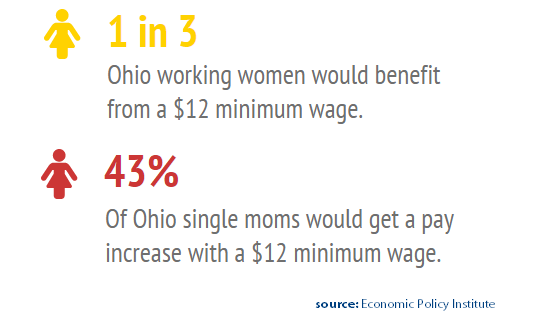
 The U.S. is one of only 3 countries in the world with no legal right to paid time off work for pregnancy, childbirth and infant care. Only half of U.S. Workers are eligible for time off without pay. As a result of the lack of a national policy, only 13 percent of workers enjoy any paid family leave benefits through their employers.
Last week, Senator Kirsten Gillibrand introduced the Family and Medical Insurance Leave (FAMILY) Act, an insurance program funded by payroll deductions that would fund paid time off for all workers, regardless of where they work. Ohio Senator Sherrod Brown has signed on as a cosponsor of S.786, but to date, Senator Rob Portman has not taken a position.
Ohio families shouldn’t have to choose between a paycheck and caring for a loved one.
The U.S. is one of only 3 countries in the world with no legal right to paid time off work for pregnancy, childbirth and infant care. Only half of U.S. Workers are eligible for time off without pay. As a result of the lack of a national policy, only 13 percent of workers enjoy any paid family leave benefits through their employers.
Last week, Senator Kirsten Gillibrand introduced the Family and Medical Insurance Leave (FAMILY) Act, an insurance program funded by payroll deductions that would fund paid time off for all workers, regardless of where they work. Ohio Senator Sherrod Brown has signed on as a cosponsor of S.786, but to date, Senator Rob Portman has not taken a position.
Ohio families shouldn’t have to choose between a paycheck and caring for a loved one.